Gaziantep in Turkey: A Food Lover’s Travel Guide
The Art of Living in Turkey contains affiliate links and is a member of the Amazon Services LLC Associates Program. If you make a purchase using one of these Amazon links, I may receive compensation at no extra cost to you. See my Disclaimers for more information.
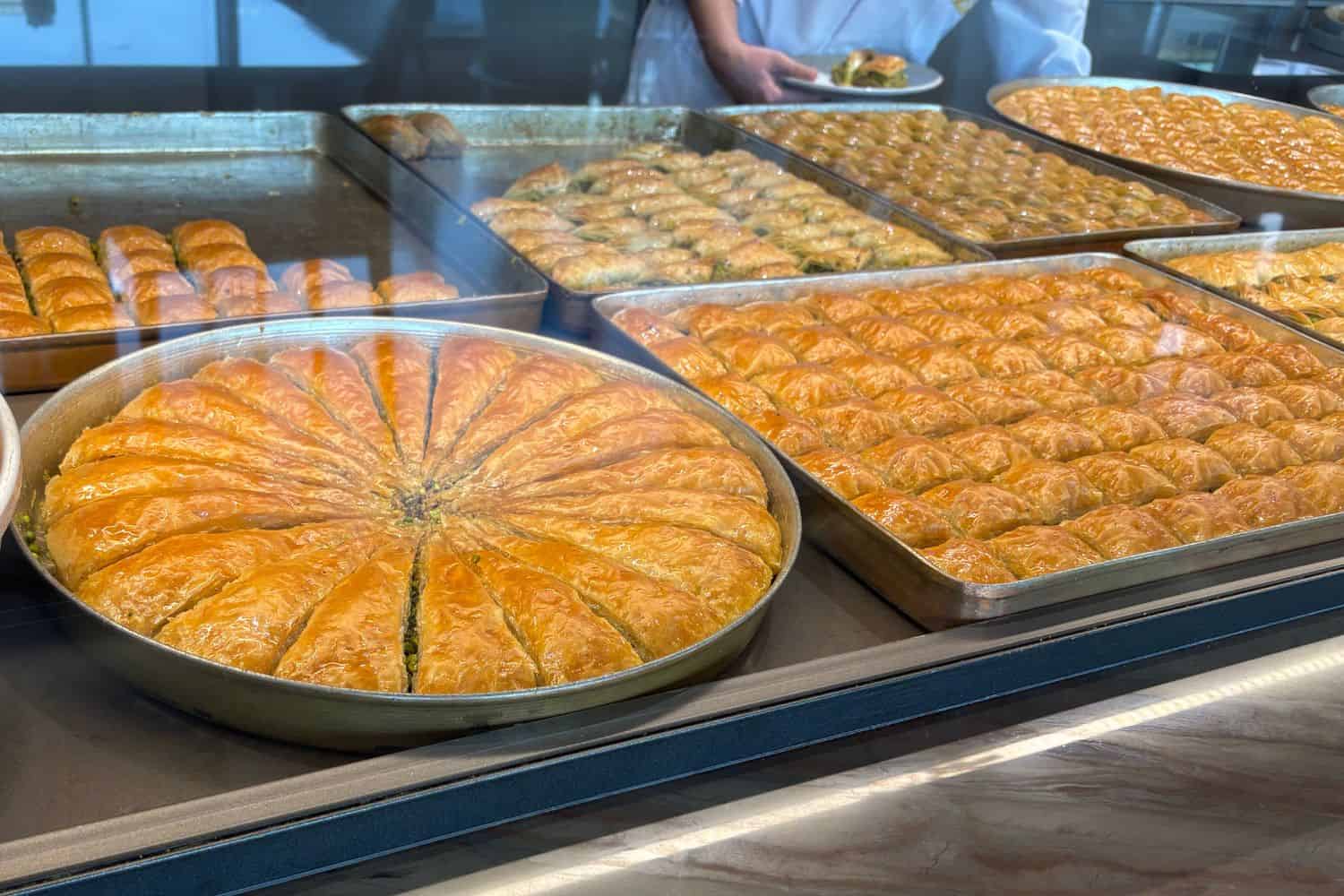
Gaziantep is widely considered the gastronomic capital of Turkey, famous for its pistachios, kebabs, and centuries-old food traditions. On a four-day family trip, we set out to experience the city not as food critics or experts—but as curious travelers following local recommendations, eating our way through history.
I love food. Food has the power to bring people together, tell a story, and carry culture.
My family loves food. We’ve lived in Turkey for 18 years, but there are still lots of places we haven’t visited, and tastes we haven’t tried.
When the fam was trying to decide on a destination for my daughter’s fall break this year, we put a few options on the table.
Pamukkale for limestone travertines and a hot air balloon ride? Troy for Greek history and walks along the Dardanelles Strait? Gaziantep for beyran soup and baklava? Guess what we picked? Food for the win!
In this post, I’m not going to try to be the “definitive guide” or give you the top 10 places to get baklava. There are plenty of great guides listing the ‘best’ places to eat—and I consulted several of them myself.
I’d like to just share the story of our trip to Gaziantep, share the spots that my local friends suggested, and let you know some things I wish I had known before I went.
Hopefully, you’ll get a little glimpse of why this city is so worth exploring.
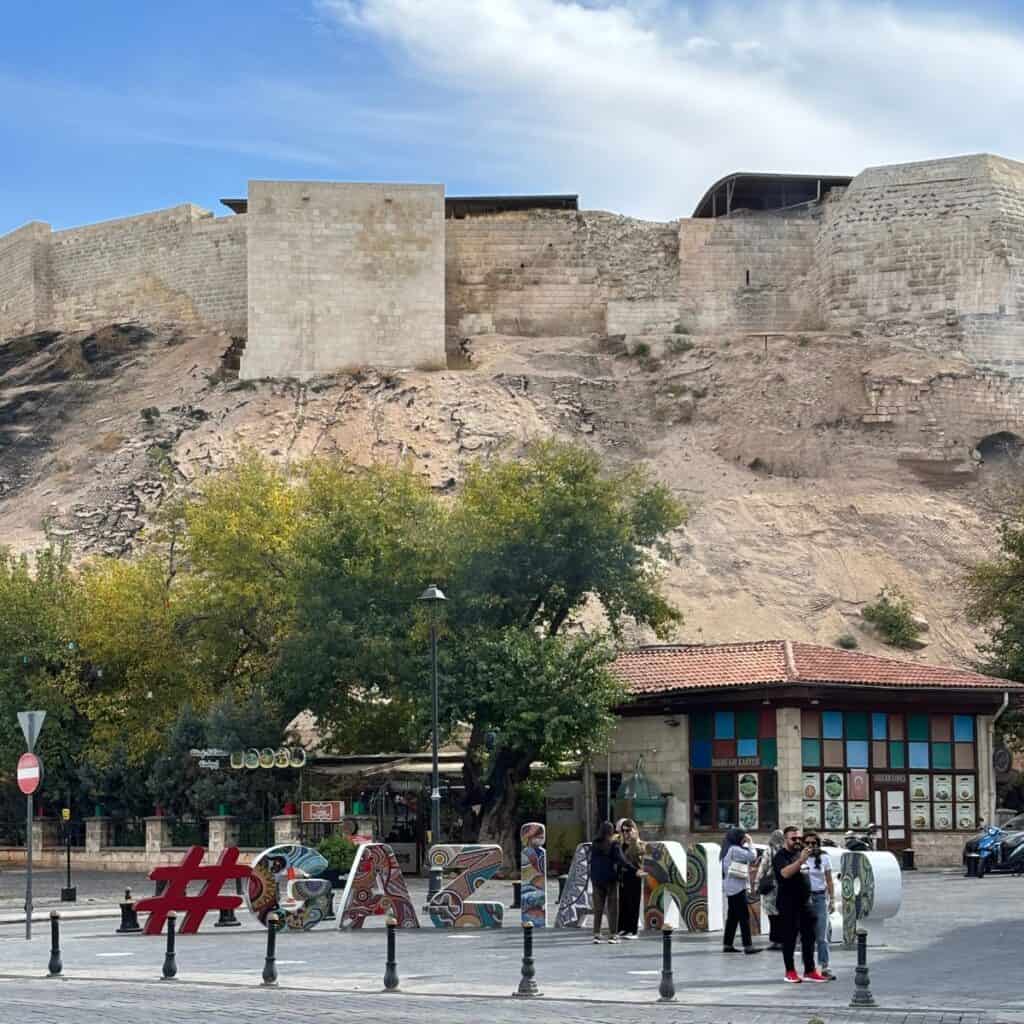
Did you know that Gaziantep and Antep are the same city? Confusing, I know. The city of Gaziantep was historically known as “Aintab” in Ottoman Turkish (possibly meaning “spring”).
But in 1921, after the Turkish War of Independence, Mustafa Kemal Atatürk gave the city the nickname “Gazi” (meaning “military conqueror”), to honor its role in helping to win the war. So the official name of the city became “Gaziantep.”
Gaziantep is only 60 miles north of the Syrian city of Aleppo, and it is a mix of ethnic Turks with many other minority groups. And it’s big! With about 2 million people, Gaziantep is the fifth largest city in Turkey.
But enough about history…let’s get to the food.
Day 1: Stews, Sweets, and First Impressions
We arrived in town on a Thursday afternoon, and as we came out of baggage claim, we followed the crowd to the Havaş bus that takes people 30 minutes to the main part of the city.
We paid 170 Turkish Lira (about $4.50) per person, and the driver dropped off people along the way based on the hotel where they were staying.
We used booking.com to get a family room at Novotel, and we enjoyed our experience there. It was a slightly more upscale hotel than some of the more traditional konak hotels in the historic part of town.
The main downside of Novotel was that it was about 10-15 minutes to the town center, but walking just helped us digest, so we could eat more. 🙂
After a bit of unpacking, we walked to the castle area, where most of the traditional shopping streets and restaurants are. Our first meal was at Yesemek–and it was a definite Yes from us!
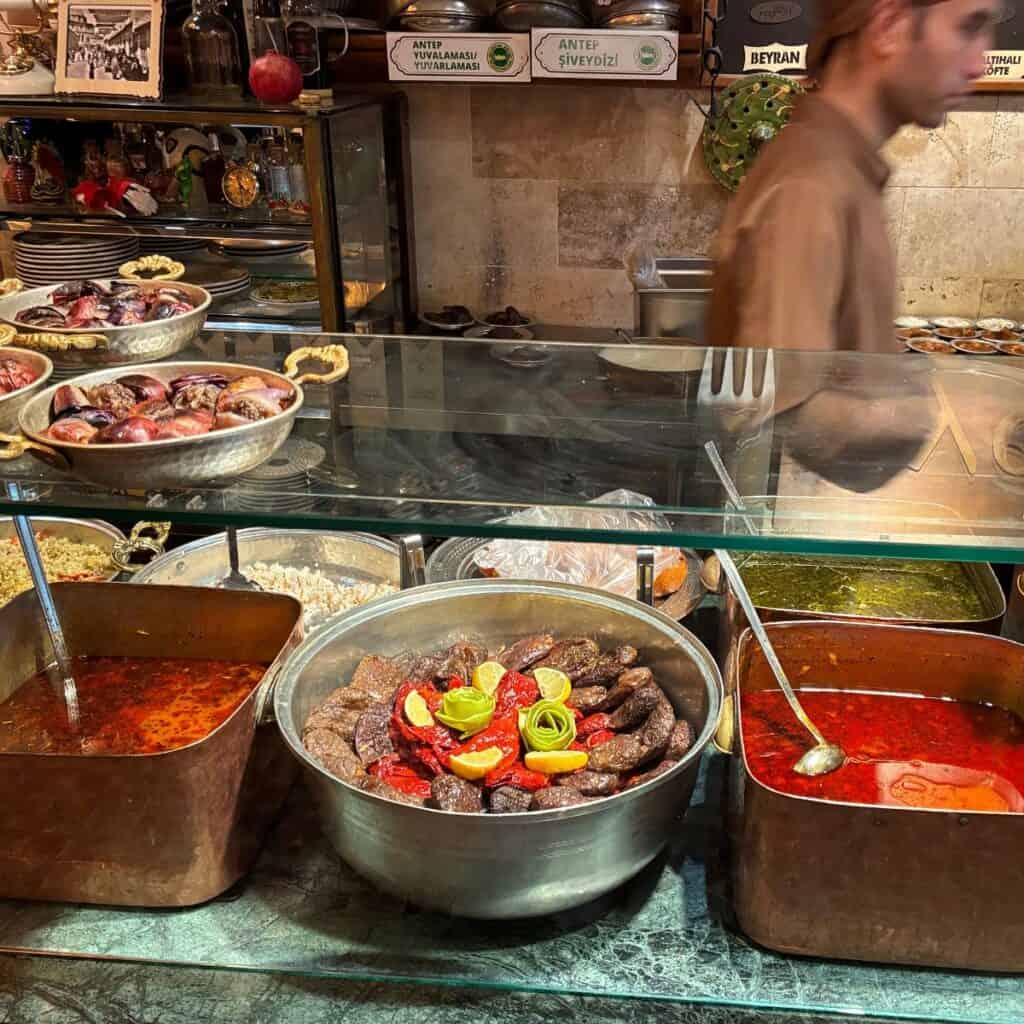
Yesemek serves local Gaziantep home-style foods. We devoured the içli köfte (kibbeh balls, bulgur on the outside and spiced meat on the inside) and stuffed rehydrated eggplant and peppers (pictured above), but we also enjoyed an assortment of some of the local stews.
Of those, the potato stew in a creamy base with saffron stood out to us.
After our dinner, we followed a local friend’s suggestion to get pistachio pastries (katmer) at Katmerci Zekeriya Usta.
For the uninitiated, katmer is like a freshly made baklava, served hot, where instead of 100 layers stacked on top of each other, it’s just one wide square of impossibly thin and flaky pastry, filled with fresh clotted cream, crushed pistachios, and sugar.
When we walked into the little shopping cul-de-sac where the restaurant is, it did not seem very impressive. It was a bit of a hole in the wall with low tables outside. But then we saw the open kitchen where they were making the magic.
A team of 3 men rolled out the dough, filled it, folded it, and placed it in a burning hot oven. Five minutes later, heaven on a plate.
Our only regret was not following our local friend’s advice to ask for az şeker, less sugar. Our family’s dessert palate is generally less sweet than our Turkish friends’, so we found the katmer delicious but too sweet. We determined to come back and try again…
Day 2: Mosaics, Beyran, and Baklava
On day 2, we took a slow morning and hoped to have a relaxed Turkish breakfast at the Udma Peynir Muzesi & Restoran. However, when I called to make a reservation, they said they fill up 2-3 days ahead of time! Note to self: next time we go to town, make a reservation when I buy the plane tickets…
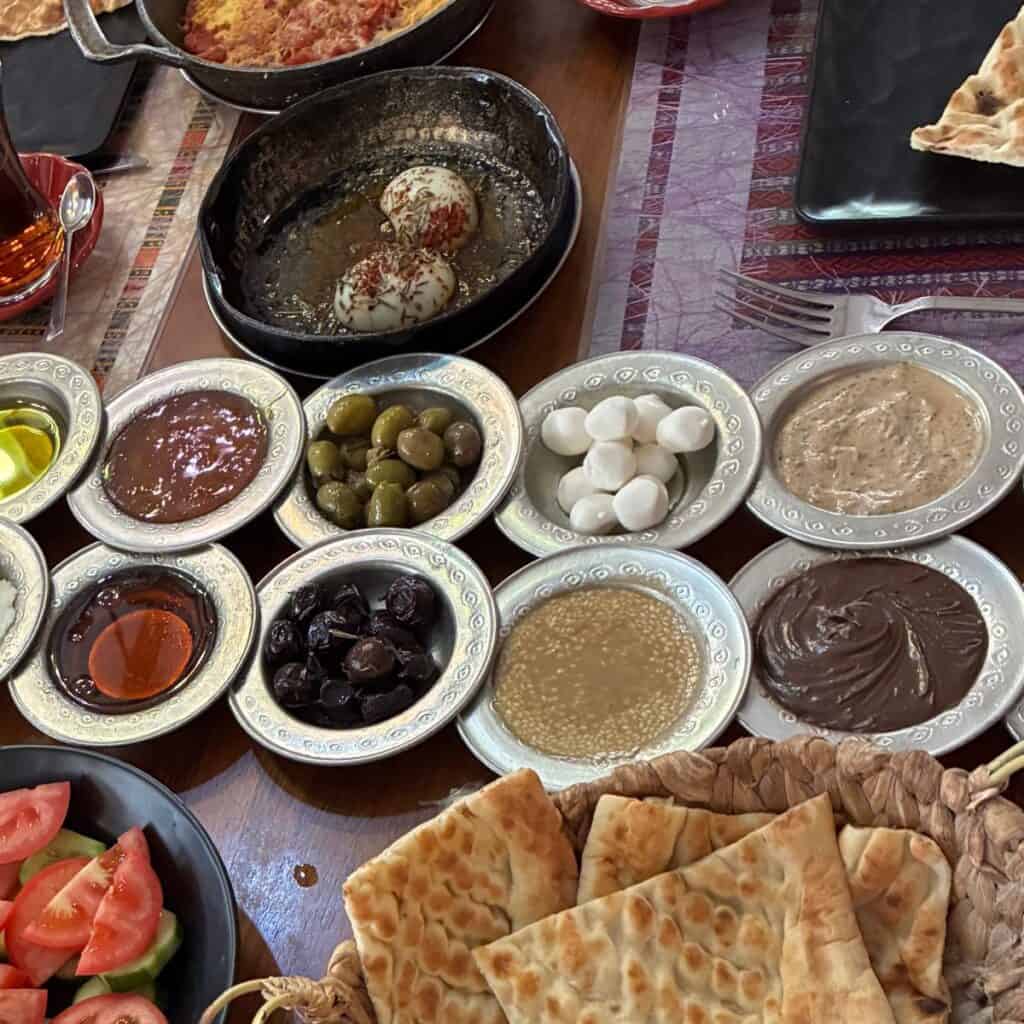
Undeterred, we went to the next option on the list and headed to Gale Alti Kafe&Kahvalti. We were not disappointed! We loved the variety of local small plates, including Antep cheese.
This cheese is preserved in a lot of salt, so when it’s served, they cut it into small pieces and pour boiling water over it. The texture of the cheese reminded me of Wisconsin cheese curds (squeaky on your teeth!).
There were also some unique delights like smashed spiced chickpeas, chopped lamb liver sautee, spicy tomato and egg (menemen), and olive oil and zahter (Arabic-style spice mix). We left very full.
After our post-brunch nap, we headed to the famous Zeugma Mozaic Museum. We had an enjoyable hour and a half taking in the amazing art, which was so practical and functional back in Roman times. If I were wealthy, I’d commission an artist to cover my floor with amazing mosaic tile designs, I guess!
One of the symbols of Gaziantep is a mosaic called the “Gypsy Girl,” and it was displayed in a separate dark room with dramatic lighting. Apparently, the way her eyes are made, they seem to “follow” you around the room, like the Mona Lisa.
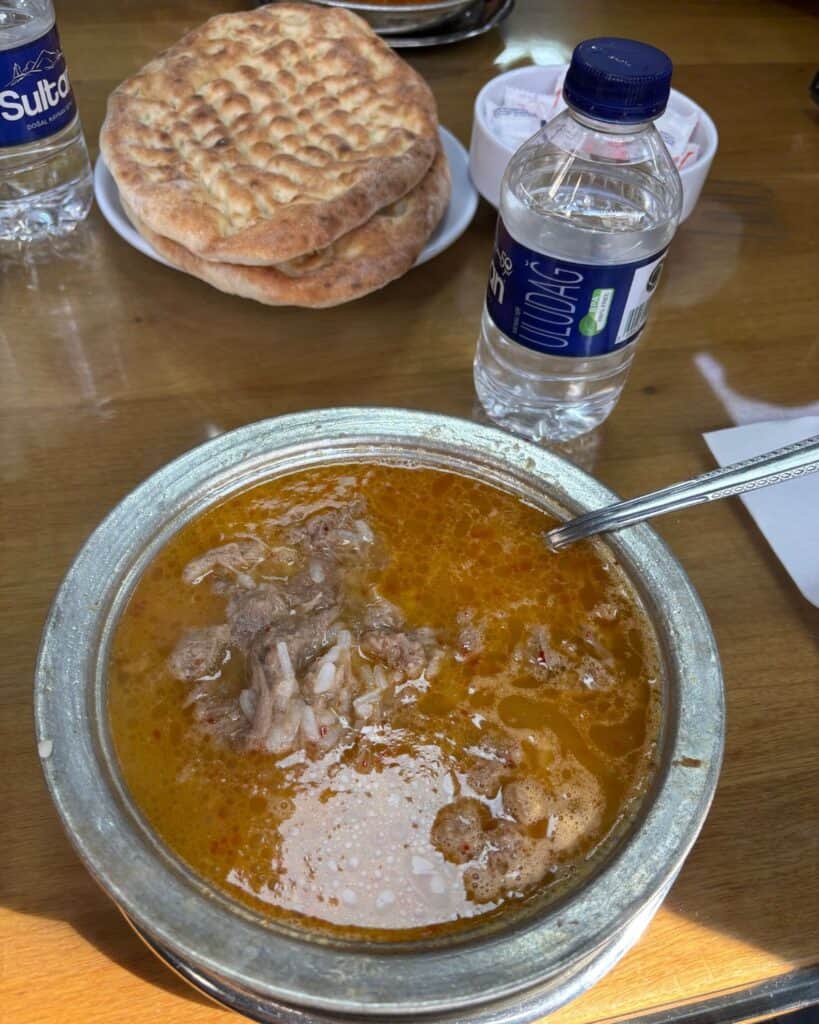
After being stared at by the Gypsy Girl, we took a taxi to Metanet Lokantasi, known for its version of Gaziantep’s famous beyran soup. Beyran is a long, slow-cooked lamb broth with rice, shredded meat, red pepper flakes, and garlic. It’s glorious and one of the city’s most iconic dishes..
We went to Metanet at 4 pm, and we were shocked when the waiter told us there was no food left. NO FOOD? How is that possible?
Apparently, beyran is more of a breakfast item, and this restaurant starts serving at 5 a.m. They officially close at 5 p.m., but on busy days, they run out of food early. We determined to come early the next day, and decided to try another well-known place called Imam Çağdaş Kebab ve Baklava Salonu.
Thankfully, Imam Cagdas had food–but even here, we were too late to enjoy one of the dishes on our list, küşleme. Kusleme is basically lamb filet mignon, and they only have so much of it each day.
It was just as well, because the “regular” lamb kebab, eggplant kebab, and Ali Nazik (grilled meat on a bed of yogurty roasted eggplant) were delicious. We loved drinking ayran (salty yogurt) out of a bowl with a ladle in the traditional style, and the fresh green salads were also wonderful.
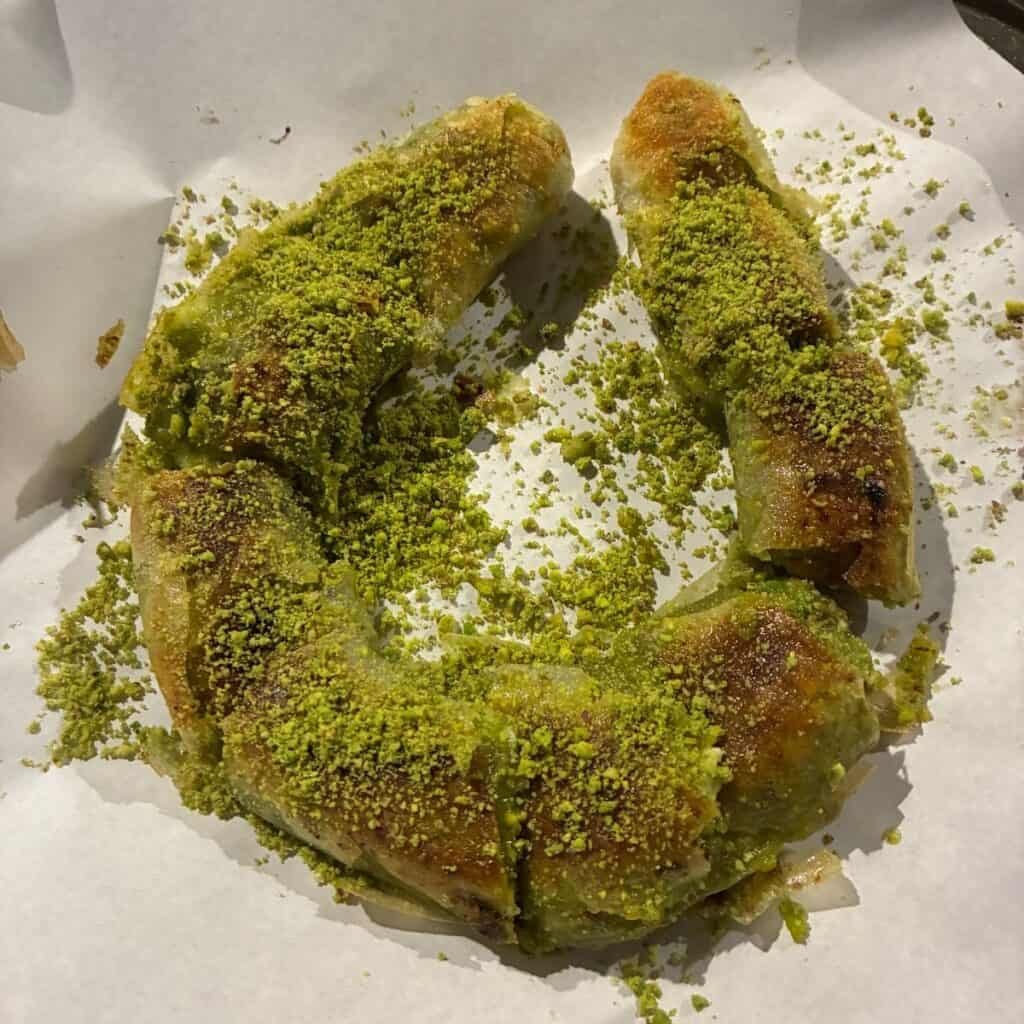
After our feast at Imam Cagdas, we had to circle back to Katmerci Zekeriya Usta again, this time for our az sekerli katmer. My daughter and I also decided to go wild and try a different shape for our katmer: the simit, or ring/circular shape.
This hit the spot–a bit more clotted cream than the normal flat square of pastry, and a bit less sugar. Perfect.
With full tummies, we wandered around the little shopping streets in the heart of town. The Bakircilar Carsisi (Copper-makers Market) is an outdoor covered market, and we enjoyed picking up some souvenirs.
We got a small copper pan (lined with tin) and some copper earrings, some pestil (the original fruit leather, made of grape molasses), and almonds covered in sugar mixed with pistachio. The sugared almonds looked like wasabi peas but tasted like extra nutty Jordan almonds.
We also enjoyed window shopping in the Zincirli Bedesten (a market inside a building) and the Almaci Pazari.
Day 3: Chickpeas, Coffee, and Culinary Surprises
Day 3 was our last full day, and we had some serious eating to do.
Breakfast and Coffee
We started our day by making a beeline for Metanet. We arrived at 9:30 am on a Saturday morning, and most of the tables were full. We ended up sharing a table with a local Gaziantep resident and his two friends from out of town.
As we enjoyed our beyran soup, we asked the local what it was like to be here during the February 2023 earthquake. He showed us videos of the damage to his house from the quake, and explained how terrifying that time was.
That month, the epicenters of three of the four most significant earthquakes in the region were in Gaziantep province. However, the overall damage to the city was actually less than that of some of the surrounding provinces.
As we walked around the city, we did see some buildings that were clearly rebuilt in the last 2.5 years, but many that were older and still standing. People are amazingly resilient.
The beyran at Metanet was good, but surprisingly a little short on garlic. We thought some places where we’ve had it in Istanbul were actually better! But the environment at Metanet was 10 out of 10. It was a good thing we came at 9:30 a.m., because by 10:30 a.m., there was a line 15 people deep for a seat.
After our breakfast soup, we went to the famous Tahmis Kahvesi (historic coffeehouse) for a special hot drink called menengiç kahvesi. Clocking in at 390 years old, Tahmis is probably the oldest coffee shop I’ve ever been in.
Menengic (terebinth) trees are a cousin of the pistachio, and the seeds are ground and boiled for a nutty, smooth drink with no caffeine. Delicious!
In Gaziantep, every place seems to have its own baklava. Tahmis was no different, and their pastry was fresh, buttery, and flaky.
Lunch and the best baklava
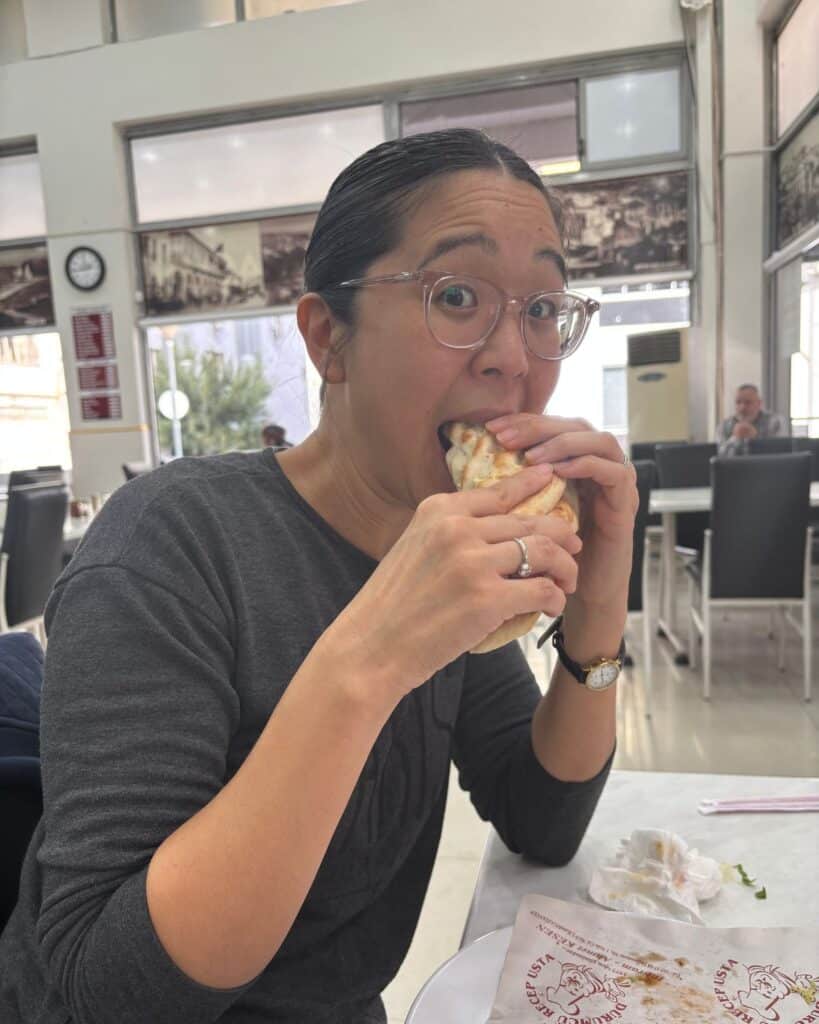
After a bit more shopping, we decided it was time for lunch. We walked over to Dürümcü Recep Usta for some famous Gaziantep nohut dürümü (chickpea wraps).
My expat friend Kim had told me that when her husband went on a trip to Gaziantep recently, he brought her back one of these wraps. She said it was one of the most delicious things she had ever eaten here in Turkey.
To be honest, that felt a bit odd to me. How could a chickpea wrap (and one that had just been on an airplane journey, no less) compare with an iskender döner or a good kebab?
Maybe because we had low expectations, when we took our first bite of the chickpea wrap, we were blown away. (Shocking, I know!)
The chickpea mash was a bit like Mexican refried beans. Silky consistency, great spices, just enough texture. The mash was put on a bed of freshly baked flat bread, and then layered with fried potatoes, eggplant, and some fresh greens.
A squeeze of lemon and a shake of red pepper flakes, and it was really quite remarkable.
Our family is generally not a big fan of liver (my husband says it smells like old Korean cabinetry), but we also tried the chopped spiced liver wrap, and we were glad we did. No cabinetry smells here! Just an amazing culinary experience.
It also helped that these wraps were 75 lira (less than $2) each, by far the cheapest thing in our travels.
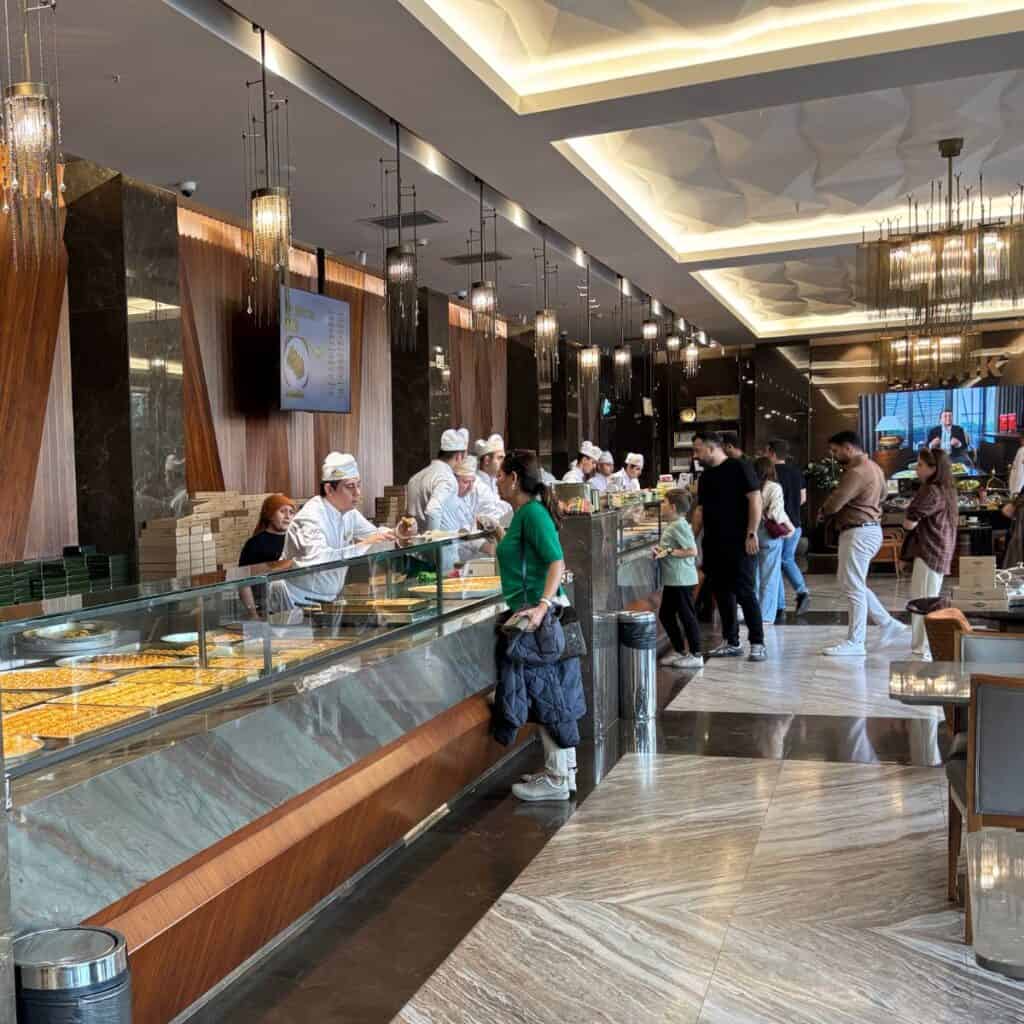
After lunch, we visited the Koçak Baklava flagship store. Wow, that was an experience! My local friend promised that this was basically the best baklava in the world, and he was not exaggerating.
We tried a variety of different styles of baklava from their extensive and shiny counter. Everything was chock full of nuts, fresh and flaky, and not overly syrupy. Perfect.
Zoo and Dinner
After baklava, we took a 30-minute taxi to the Gaziantep Zoo to walk off some calories and enjoy some nature.
The drive to the zoo helped us get a feel for the size of Gaziantep. We passed street after street of residential blocks, plus the state university and a number of hospitals.
The zoo itself is the largest in Turkey, and it was a nice way to spend a few hours. Generally speaking, you have to be prepared to see animals in less-than-ideal living conditions; the hippopotamus family seemed to be a bit stressed as it swam in circles in its mini lake. However, the lions were amazing, we went at dusk, and we heard their majestic roar.
To close off our time in Gaziantep, we decided to try a local friend’s suggestion and check out a Yemeni restaurant.
Hadramout had some booths where you could sit on the floor in a traditional way, and Western-style tables if that’s your pleasure. We enjoyed a floor booth and liked being able to stretch out and rest from all our walking.
We ordered a traditional Yemeni beef stew that came out bubbling on a hot stone casserole dish, and a tender, well-spiced half chicken on a bed of saffron rice. The fresh flat bread and cucumber tomato salad were a great complement to these dishes.
Day 4: Saying Goodbye to Gaziantep
The next morning, our flight back to Istanbul was early, so we caught the Havas airport bus in front of our hotel and said goodbye to Gaziantep.
To give you some ballpark figures, our family spent about $350 per person for our 4-day trip, including a flight from Istanbul, hotel, food, and shopping. The price for a nice dinner was about $15; a portion of baklava and tea was about $10; and a chickpea wrap was $2.
I still have a few places on our list to save for the next time I get a chance to come here. I’ve heard Sakip Usta and Kelebek are great for beyran, Metanet has a katmer shop across the street from its beyran operation, and I’d like to get kusleme (lamb filet mignon) at Kusleme Kebabhan sometime.
Even so, I’m glad we got a few days in this amazing city of gastronomy. The memories of this time with my family around food will be a source of joy for many years to come!
What’s on your Turkish food bucket list?
As you make your way back to Istanbul, make sure you stay for even a couple of days to see all of the things. Here are a few of our favorite posts about the largest city in Türkiye.
- Before you go, make sure you know these things
- Looking for a place to stay in Istanbul? Here are our favorites.
- A short 3 day itinerary to help you see the highlights
- Don’t bother with the rental. Here is the DL on public transportation.
- Make sure you read this before going shopping
- Plan to take taxis? This will help
- 7 Famous Churches and Mosques in Istanbul
- More food? Check out these food tours
Turkey Vacation Basics
When I plan a trip these are the websites I use. I hope they help you plan your next adventure as well!
FLIGHTS: I am a huge fan of Skyscanner.
VISAS: You can use the free e-visa portal here but for a few extra dollars you can use iVisa and someone else will handle any issues that may come up.
E-SIM: When I traveled to SE Asia I discovered e-sims and I’m never going back. Airalo has been easy and cheap!
TRAVEL INSURANCE: I use TravelInsurance.com for my trips abroad.
CAR RENTAL: I have loved working with Discover Cars when I rent cars in country.
AIRPORT TRANSFERS: I have used these transfers many times and they are always great. If you’d like more options, I also recommend GetTransfers.com as they allow you to compare companies.
ACCOMMODATION: Find the best Turkey hotel deals on Booking.com.
CITY TOURS & DAY TRIPS: You can browse GetYourGuide’s website to find just the tour you’re looking for! We also recommend the MegaPass for major cities.
