
Türkiye Digital Nomad Visa: What You Need to Know Before You Move
The Art of Living in Turkey contains affiliate links and is a member of the Amazon Services LLC Associates Program. If you make a purchase using one of these Amazon links, I may receive compensation at no extra cost to you. See my Disclaimers for more information.
Updated August 2026
If you’ve been dreaming about living and working in Türkiye, you aren’t alone.
From the first time I stepped foot in Istanbul in 2018, I was in love. It immediately felt like home, and I was so happy to move back a year later.
Since then, I’ve had the chance to explore so much more of the country. I’ve spent time in Fethiye, Antalya, the Black Sea region, Ankara, Izmir and plenty of places in between.
And now there is a much more official way for remote workers to make Türkiye home for a while.
Türkiye’s Digital Nomad Visa program gives eligible remote workers a path to live in the country while continuing to work for employers or clients outside Türkiye.
But there is something important you need to understand before you start filling out forms.
The Digital Nomad Identification Certificate is not the same thing as the Digital Nomad Visa, and the visa is not the same thing as your residence permit.
There are several steps to the process, and understanding how they fit together will save you a lot of confusion later.
So let’s talk about how the Türkiye Digital Nomad Visa actually works, who can apply, what you’ll need, what it costs, and what happens once you arrive.
Why Choose Türkiye as a Digital Nomad?
If you’re going to work remotely somewhere, why not do it somewhere beautiful?
Türkiye really does have something for everyone. You have Istanbul with its incredible food, neighborhoods, history and endless things to do, but you also have Mediterranean beaches, mountains, hiking, winter sports, ancient cities, UNESCO sites and some of the best food you’ll ever eat.
There are food tours, wine regions, beaches, things to do in the fall, spring in Istanbul, winter activities and plenty to keep you busy in the summer.
You could easily stay in Istanbul, Izmir or Antalya and use one of those cities as a home base while traveling around the country. That’s one of the things I love about Türkiye. You don’t have to choose between city life, the beach, mountains or small towns because you can experience all of them.
You can even travel internationally from Türkiye relatively easily, including to Europe, Albania and Northern Cyprus.
But honestly, the biggest reason I think Türkiye is such an interesting place for a digital nomad has nothing to do with how many beautiful places you can visit.
It’s the opportunity to actually live here.
There is a huge difference between spending two weeks in Türkiye and waking up here every morning. It’s having a neighborhood grocery store, a favorite cafe, people who recognize you and neighborhoods that slowly start to feel like your own.
That’s the part I loved about living in Istanbul.
Who Can Apply for the Türkiye Digital Nomad Visa?
The Türkiye Digital Nomad Visa is available to citizens of specific countries, including the United States, Canada, the United Kingdom, Switzerland, Norway, Iceland, Liechtenstein and a number of European countries. Though recently, Russia, Ukraine and Belarus were added to the list.
There are also several requirements you’ll need to meet before you can apply for the Digital Nomad Identification Certificate.
You must be between 21 and 55 years old
The program is designed for working-age remote professionals, so applicants must be between 21 and 55 years old. This isn’t a great option for those looking to retire somewhere.
You need a valid passport
Your passport needs to be valid for at least six months from your arrival, but honestly, I would want considerably more than that if I were planning to move. There’s no reason to start the process with a passport that is about to expire.
This is something you’ll want to check before you get too far into the application process because renewing a passport is much easier to deal with before you start making travel plans.
You need a university degree
One of the requirements is a diploma or other certification showing that you are a university graduate. You’ll need to provide documentation of your degree as part of the Digital Nomad Identification Certificate application.
You need to meet the income requirement
The current income requirement is $3,000 USD per month or $36,000 USD per year. You’ll need documentation showing that you meet that requirement rather than simply stating that you earn enough.
You need to work remotely
The program is designed for people who work remotely for companies or clients outside Türkiye. If you’re employed, you’ll need documentation showing your employment, while self-employed applicants need documentation showing their qualifying business or client relationship.
You need a biometric photograph
You’ll also need a biometric photograph for the application. Make sure you use a current photo that meets the requirements rather than assuming any passport-style picture will work.
How the Türkiye Digital Nomad Visa Process Works
This is where I think the process can get confusing because there are several different terms being used.
The first step is the Digital Nomad Identification Certificate. Once you have that certificate, you can move on to the actual Digital Nomad Visa application through the appropriate Turkish visa center or consulate.
Then, once you enter Türkiye, the residence permit is a separate part of the process.
People whose Digital Nomad Visa applications are positively evaluated can apply for a six-month short-term residence permit for tourism purposes through e-İkamet while they are in Türkiye and within the visa period.
So, in simple terms:
Digital Nomad Identification Certificate → Digital Nomad Visa → Enter Türkiye → Residence Permit
That distinction is important because the certificate is not the visa, and the visa is not your residence permit.
Step 1: Apply for the Digital Nomad Identification Certificate
The first part of the process is completed online through the official GoTürkiye Digital Nomad Portal. You’ll create an account and upload scanned copies of the documents needed to show that you meet the digital nomad requirements.
The platform reviews your documents to determine whether you qualify. If your documents are sufficient, you’ll receive your Digital Nomad Identification Certificate, which allows you to move forward with the visa application.
The certificate is not your visa.
Think of it as the first major step in the process. You still need to complete the visa application through the appropriate Turkish visa center or consulate.
Step 2: Apply for the Digital Nomad Visa
Once you have your Digital Nomad Identification Certificate, you’ll take that certificate along with the other required documents to the appropriate Turkish visa center or consulate.
GoTürkiye guidance specifically says that the certificate is used to apply for the Digital Nomad Visa.
If you’re applying from the United States, make sure you’re looking at the instructions for the Turkish consulate responsible for your area.
I would not assume that a checklist you find online from another American applicant, or even another Turkish consulate, will necessarily be identical to yours.
This is one of those situations where it pays to go directly to the source.
Step 3: Apply for Your Residence Permit
This is probably the part of the process that is easiest to misunderstand. Getting your Digital Nomad Visa does not mean that you’ve completed the entire residence process.
Positively evaluated digital nomad visa holders can apply for a six-month short-term residence permit for tourism purposes through e-İkamet after entering Türkiye and while still within the visa period.
Pro tip: it is better to use this site in Turkish with a translator plugin. The English version crashes often and sometimes you can lose all the data you put in before you can save it. #askmehowiknow
Residence permit applications are handled through Türkiye’s Presidency of Migration Management, and the official system for applications is e-İkamet.
Don’t assume that the length of your visa automatically tells you how long you can remain in Türkiye.
Look at the actual documents you receive and follow the instructions associated with your particular application.
What Documents Do You Need?
For the initial Digital Nomad Identification Certificate, the requirements include:
- a passport or travel document valid for at least six months from arrival
- a university diploma or degree certification
- documentation showing that you work in the digital nomad field
- a biometric photograph and proof of the required income
- employees also need documentation showing their employment with a company outside Türkiye, while self-employed applicants need documentation showing their qualifying business relationship.
Once you move into the visa and residence permit stages, there may be additional documentation involved. Depending on your situation, that can include:
- passport copies
- health insurance
- proof of residence
- photographs
- translations
- notarizations
- other documents requested by the consulate or immigration authorities.
This is one area where I would not rely on a random checklist from another applicant though it is a good start. Check the current requirements for your specific application.
Immigration paperwork has a funny way of changing just when you think you’ve got it figured out. Every time I applied it was different. .
the Actual costs of a Digital Nomad Visa
This is one area where you’ll find a lot of conflicting information online.
I have seen websites give one flat dollar amount for the Türkiye Digital Nomad Visa, but that’s not a number I would rely on without checking the current official fees for your nationality and application location.
Türkiye publishes visa fees separately from residence permit fees, and the applicable amount can depend on the type of visa and the applicant.
The Digital Nomad Identification Certificate itself does not currently have a separate application fee listed on the GoTürkiye application page. The visa application comes afterward, and then there are potentially additional costs associated with your residence permit.
For 2026, Türkiye’s official residence permit information lists a 964 TL residence permit document fee, which is roughly $20. The residence permit fee itself is separate and can vary based on nationality and the length and type of permit, so don’t assume the 964 TL is the total cost of the residence permit.
It will also depend on how long of a duration they give on their visa as the fee is tied to length. The first month is $25 and then subsequent months is $5.
You’ll also want to budget for things such as health insurance, photographs, document translations, notarization or apostilles if they are required for your particular documents, and any travel you need to make for the visa or residence application.
Rather than thinking about the Digital Nomad Visa as having one set price, I would budget for the entire application process.
Do You Need Health Insurance?
Health insurance will be part of the residence permit process, so you’ll want to look carefully at the current requirements before purchasing a policy.
I would also recommend thinking beyond simply finding the cheapest policy that meets the requirement. If you’re actually going to live in Türkiye, you want to understand what your insurance covers and where you can use it.
I always purchased the cheaper required one, which won’t really do much of anything for you, and then purchased one that I could use in country as well as covered me for up to two months back in the States, since I didn’t carry coverage there.
Do Americans Need an FBI Background Check?
The official requirements for the Digital Nomad Identification Certificate do not list an FBI background check among the documents on the initial certificate checklist.
That doesn’t mean another document could never be requested at a later stage or for a particular application. Some friends it has been required, usually when getting a work visa, but I was never asked for it.
If you’re an American applicant and you’re considering ordering an FBI background check, apostilling your diploma or having documents translated, I would first confirm the current requirements with the Turkish consulate handling your visa application.
There’s no reason to spend money preparing documents that aren’t actually required. Simultaneously, it is incredibly handy to have if it ever is required.
How Long Can You Stay in Türkiye?
The digital nomad visa holders whose applications are positively evaluated can apply for a six-month short-term residence permit for tourism purposes through e-İkamet after entering Türkiye and within the visa period.
You may find other websites talking about one-year stays or longer residence permits, but I would not assume that those general residence permit rules automatically apply to someone using the digital nomad route.
The residence permit that you receive is what matters. Unfortunately, there is no standard. I have had couples who one spouse receives a year and the other a different amount of time.
Can You Work for a Turkish Company?
The Digital Nomad program is designed for remote work connected to companies or clients outside Türkiye. The official requirements specifically ask for documentation showing that employees work for a company outside Türkiye or that self-employed applicants have a business relationship with a company outside Türkiye.
So if your plan is to move to Türkiye and take a local job, the Digital Nomad Visa isn’t the route I would be researching. You would need to look into the appropriate Turkish work visa. They have been cracking down on this so I wouldn’t try to skirt it.
What About Taxes?
This is where I’m going to give you the advice I wish more websites gave.
Talk to a tax professional before you move. According to CPAs for Expats:
The U.S. Turkey tax treaty, signed in 1996, serves as an agreement between the two countries for determining the taxation of income where both nations may have the legal right to tax according to their respective laws.
Your tax situation can depend on things like how long you live in Türkiye, where your income comes from, where you perform your work, your employment or business structure, your citizenship and the tax treaties that apply to you.
If you’re American, I would look for a CPA or tax professional who understands both U.S. and Turkish tax considerations for people living abroad. Don’t make your tax plan based on a random blog post because the answer can be much more complicated than it first appears.
I actually moved back to America to start an olive oil business because for our situation, if I didn’t, I would have had to pay taxes in both countries and who wants that?!
Where Can You Work in Türkiye?
Pretty much wherever you can get a good internet connection.
In the last 10 years, the number of cafes and coffee shops has absolutely exploded. Everywhere I turn these days it seems like another one is being built out.
How they all remain open baffles me. But at the same time there is a lot of turn over so maybe they don’t remain open after all.
I guess it also helps that there are 16+ million people in Istanbul.
Coworking spaces have also become much more common, particularly since the pandemic. And if you’re working from home, you’ll have plenty of options in the larger cities, although I would always check the internet situation for the specific apartment or neighborhood before signing a lease.
If you’re planning to live somewhere outside one of the larger cities, I would definitely check first. Internet service can vary more than you might expect from one neighborhood to another.
Where Should a Digital Nomad Live in Türkiye?
Türkiye is huge, and every area has a completely different feel. You can choose a massive city, a coastal town, a mountain community or somewhere in between depending on the kind of life you’re looking for.
Istanbul
If you thrive on hustle and bustle, Istanbul is probably a great bet for you. Think of it as the New York City of Türkiye with twice as many people.
There is always something happening, and you could spend years exploring the neighborhoods and still find somewhere you’ve never been. There are cafes everywhere, plenty of restaurants, coworking spaces and more things to do than you’ll ever have time for.
Personally, I can’t stand the European side of Istanbul, but the Asian side feels just right. But you gotta travel to know this for yourself. Kadıköy is where I lived all but a year and wouldn’t have traded it for anything.
Antalya
If you really love heat and beaches, Antalya may be a good fit.
You’ve got the Mediterranean, beautiful coastline and a much different pace of life than Istanbul. If your ideal workday involves closing your laptop and heading to the beach, it’s certainly worth considering.
Be advised that the summers are incredibly toasty. I can’t do it but I had many friends who love it down there.
Izmir
If you want something a little more relaxed with temperate weather, the Izmir area might be your jam.
It’s a great option for someone who wants access to a larger city without quite as much intensity as Istanbul. And, of course, you’re also close to some fantastic coastal areas.
If I lived anywhere else other than Istanbul, it would be Izmir.
Fethiye
Fethiye is another completely different experience.
It’s beautiful, outdoorsy and surrounded by spectacular coastline, so it can be a great fit if you want a slower lifestyle and plenty of opportunities to get outside.
While I don’t know if I would want to live here, especially as a single woman, it is definitely one of my favorite places to visit. I think I have been there more than anywhere else.
Bodrum, Dalaman and Marmaris
Then there are the other coastal areas, each with its own personality.
Some are busy and developed, while others are much quieter, and some change dramatically depending on the season. That’s why I wouldn’t choose your new home based entirely on a few pretty pictures online.
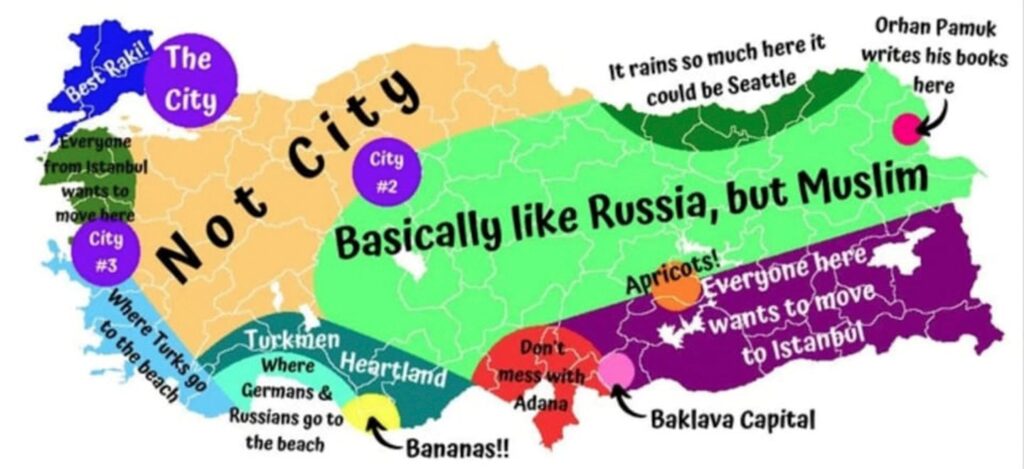
In these cities, you’ll see different ethnicity populations. Check out this funny map of where people live to get a feel for it. Take it with a grain of salt.
Don’t Pick Your New Home From Instagram
Seriously.
I know a place looks amazing in photos, but that doesn’t necessarily mean you want to live there. Before signing a long-term lease, spend some time in the area and experience what everyday life actually feels like.
Get groceries. Work from a cafe. Take public transportation (nowhere is as connected as Istanbul). Walk around the neighborhood.
Figure out what it’s like when you’re not on vacation.
Every city has a different feel, and sometimes the place you think you’ll love isn’t actually the place that fits your lifestyle. You won’t know until you spend some time there.
That’s one of the great things about living in Türkiye. You have choices.
What About Learning Turkish?
Turkish is the local language and let me tell you…It isn’t easy to learn. I took AP chemistry and Calculus and I have never felt more stupid in my life.
That being said, being able to speak another language makes me feel like such a badass. Being able to go to the grocery store and chitchat and make their day is euphoric.
My favorites are the Turks who ask if I am Turkish. *cue the tears.
I love walking down the street and passing my local grocer and saying hello and wishing this older man a good day. When I sprained my ankle and a friend went to the store to grab a few things for me, she had me on video and I got to say hi to him.
He went on and on about how I had such a pure heart. All from speaking his language and showing kindness. That’s one of the things I love about living here.
You don’t have to speak perfect Turkish, and you certainly don’t need to be fluent before you move. But learning even a little bit changes your experience because you start interacting with people differently and understanding little things you would completely miss as a tourist.
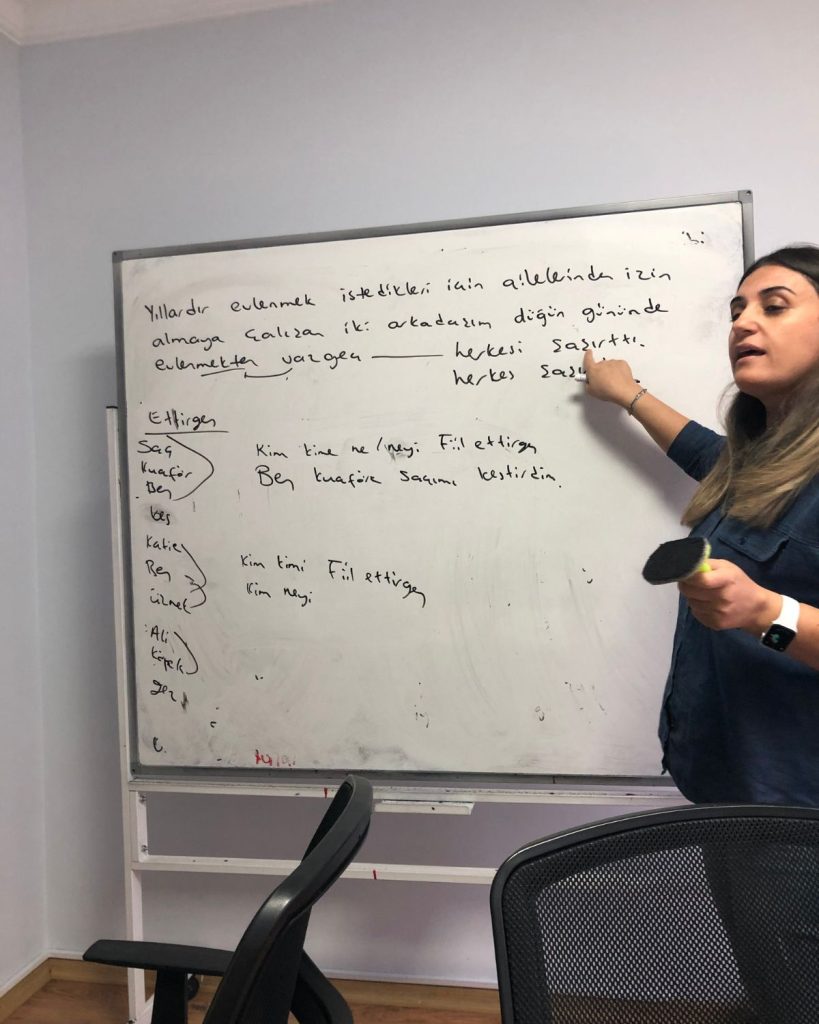
I have some great resources if you’re looking to learn Turkish. I started with Turkish Now and eventually moved to private lessons, and I’m soooo glad I did.
If you stay in Türkiye, you’ll learn as you travel and interact with locals. And yes, there is also a pretty extensive expat community here, especially in Istanbul.
But learn some Turkish. Trust me. It is most definitely worth the investment.
My two favorite options are Turkish Now for group lessons and if you’re interested in private lessons I’ll give you the number to a bestie who was an incredible Turkish teacher. Just drop me an email and I’ll get you the info.
One thing I will say is group lessons were helpful for me. I wouldn’t have been able to do private right away because it helped learning where others had issues. But then I couldn’t do group anymore. Try them both out and see what would fit you best.
Is Türkiye a Good Place for Digital Nomads?
I think Türkiye can be an incredible place for digital nomads, but I wouldn’t recommend moving here simply because you can work remotely.
Come because you actually want to experience the country.
There are beautiful places everywhere, incredible food, a fascinating history and so many different ways to live. You can build a completely different lifestyle in Istanbul than you would in Fethiye, Antalya or Izmir.
And that’s what I love about Türkiye. You can build a life here. You can have a routine. You can travel. You can learn the language. You can make friends.
You can find your favorite neighborhood and your favorite market and the cafe where they already know what you’re going to order.
You can sit on a ferry across the Bosphorus just because you feel like it.
And eventually, you may realize that you’re not just visiting anymore.
You’re living here.
Frequently Asked Questions About the Türkiye Digital Nomad Visa
Does Turkey have a digital nomad visa?
Yes. Türkiye has a Digital Nomad Visa program, and the process begins with the Digital Nomad Identification Certificate through the official GoTürkiye platform.
Can Americans apply for the Türkiye Digital Nomad Visa?
Yes. The United States is included on the current official list of eligible nationalities.
Can I work remotely for a U.S. company while living in Türkiye?
The Digital Nomad program is designed for people working remotely for companies or clients outside Türkiye. You will need documentation showing your qualifying employment or business relationship.
Does the Digital Nomad Visa automatically give me a residence permit?
No. The residence permit is a separate part of the process, and current guidance says positively evaluated digital nomad visa holders can apply for a six-month short-term residence permit for tourism purposes through e-İkamet after entering Türkiye and while within the visa period.
How much does the Digital Nomad Visa cost?
There isn’t one simple number that applies to every applicant. You’ll need to consider the applicable visa fee, residence permit fees, health insurance and other document or application expenses, and you should check the current fees for your nationality and consular jurisdiction before applying.
Does the Digital Nomad Visa lead to Turkish citizenship?
No. The Digital Nomad Visa is not a direct citizenship or permanent residence program. If your ultimate goal is to make Türkiye your permanent home, you’ll want to research the immigration routes specifically designed for long-term residence.
Can I bring my family?
Your family members do not automatically receive your immigration status simply because you have a Digital Nomad Visa. Their eligibility and residence status need to be considered separately based on your circumstances.
Work Remotely. Live in Türkiye.
If you’re looking for your next destination as a digital nomad, I definitely think Türkiye belongs on your list.
There are things to do year-round, beautiful places everywhere, incredible food and so many different ways to experience the country. You can live in a huge city, wake up near the Mediterranean or find a much quieter life somewhere along the coast.
But for me, Türkiye isn’t just a destination.
It’s a place I’ve come to call home.
Its allure goes beyond the breathtaking views, ancient churches, vibrant cities and amazing food. It’s in the warmth of its people, sitting at a cafe for two hours, knowing the guy at your neighborhood market and learning enough Turkish to have a real conversation.
It’s in figuring out which neighborhood feels like yours.
And eventually, it’s in realizing that you’re not just visiting anymore.
You’re living here.
That’s what I hope people experience when they come to Türkiye.
Not just the tourist version.
Not just the Instagram version.
The real thing.
So if you’re ready to work remotely, explore a new country and maybe discover a place that feels like home along the way, Türkiye might be calling.
Official Türkiye Digital Nomad Visa Resources
Immigration rules, fees and application procedures can change, so always check the official sources before making plans or submitting an application.
Planning a trip to Turkey? Here are some other resources
- Airalo review – my preferred eSIM when I travel
- Know how to stay in touch with the right country code for calling
- Learn all about public transportation in Istanbul
- Download the ultimate packing list
- Flying in? Learn about the Istanbul airports
Turkey Vacation Basics
When I plan a trip these are the websites I use. I hope they help you plan your next adventure as well!
FLIGHTS: I am a huge fan of Skyscanner.
VISAS: You can use the free e-visa portal here but for a few extra dollars you can use iVisa and someone else will handle any issues that may come up.
E-SIM: When I traveled to SE Asia I discovered e-sims and I’m never going back. Airalo has been easy and cheap!
TRAVEL INSURANCE: I use TravelInsurance.com for my trips abroad.
CAR RENTAL: I have loved working with Discover Cars when I rent cars in country.
AIRPORT TRANSFERS: I have used these transfers many times and they are always great. If you’d like more options, I also recommend GetTransfers.com as they allow you to compare companies.
ACCOMMODATION: Find the best Turkey hotel deals on Booking.com.
CITY TOURS & DAY TRIPS: You can browse GetYourGuide’s website to find just the tour you’re looking for! We also recommend the MegaPass for major cities.
